Standard Engineering Technology Ltd has established solid experience in supporting the food industry sector, delivering engineered solutions that prioritise hygiene, safety, efficiency, and regulatory compliance. With a strong understanding of food processing environments and international food safety standards, the company supports manufacturers across a wide range of food and beverage applications.

The company provides process equipment and systems designed for hygienic operation, cleanability, and long-term reliability. Equipment selection and design focus on materials suitable for food contact applications, including stainless steels and corrosion-resistant alloys, ensuring compatibility with cleaning-in-place (CIP) processes and compliance with food safety regulations. These solutions help manufacturers maintain consistent product quality while optimising operational efficiency.

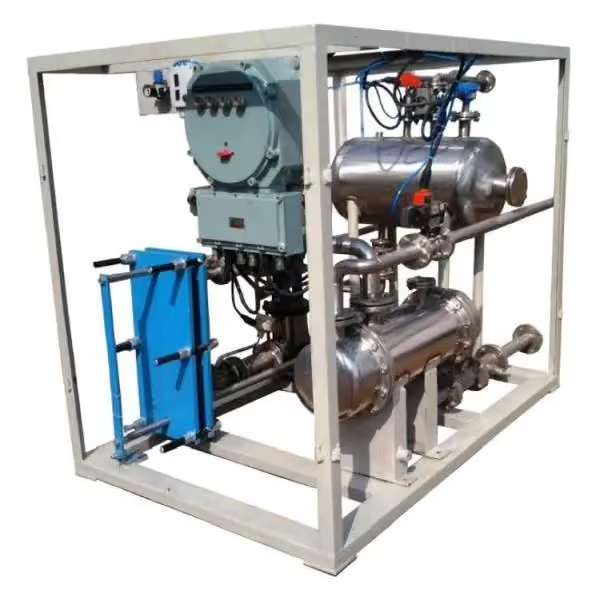
In addition, Standard Engineering Technology Ltd supplies valves, instrumentation, and ancillary systems engineered for precise process control and contamination prevention. Emphasis is placed on robust design, ease of maintenance, and seamless integration into existing production lines, supporting critical operations such as mixing, heating, cooling, transfer, and packaging.

Through its combination of engineering expertise, disciplined project execution, and strong supplier partnerships, Standard Engineering Technology Ltd continues to be a trusted partner for food industry clients seeking reliable, hygienic, and scalable solutions that support safe production and sustainable growth.

Why is surface finish important for equipment processing food?
Surface finish is critically important for equipment used in food processing because it directly affects hygiene, product quality, and regulatory compliance. Smooth, non-porous surfaces prevent food particles, bacteria, and residues from becoming trapped, reducing the risk of contamination and microbial growth. A high-quality surface finish also makes cleaning and sanitisation more effective and reliable, supporting CIP (clean-in-place) procedures and helping manufacturers meet strict food safety standards. By minimising product build-up and corrosion, an appropriate surface finish ensures consistent processing performance, protects flavour and appearance, and extends the service life of the equipment.
Why is Glass Lined Equipment used in the Food Industry?
Glass lined equipment is used in the food industry because it provides a hygienic, non-reactive, and corrosion-resistant processing environment that protects both product quality and equipment integrity. The glass lining is inert and does not impart taste, colour, or contaminants, making it ideal for food products that require high purity and strict hygiene standards. Its smooth, non-porous surface resists product build-up, simplifies cleaning, and supports effective CIP (clean-in-place) procedures, while also withstanding acids, salts, and temperature variations commonly encountered in food processing. Together, these benefits help manufacturers maintain product consistency, comply with food safety regulations, and achieve long service life from their equipment.
What is an ANFD?
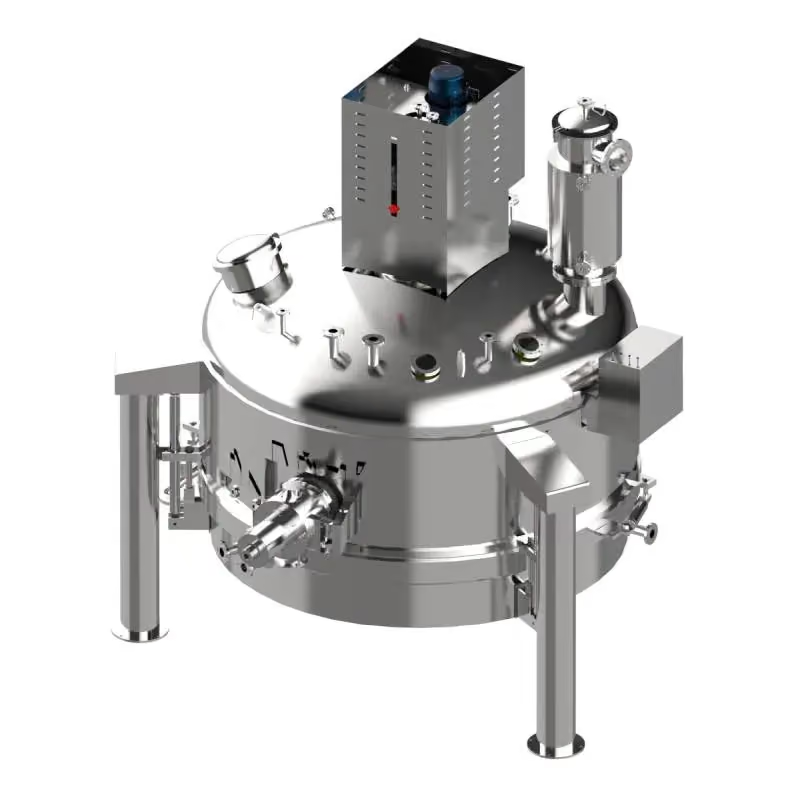
An ANFD, or Agitated Nutsche Filter Dryer, is a versatile piece of process equipment used primarily for solid–liquid separation, washing, and drying within a single closed vessel. It combines filtration and drying functions by using a filter plate to separate solids from liquids, while an internal agitator assists with cake washing, reslurrying, and uniform drying. ANFDs are widely used in chemical, pharmaceutical, and fine chemical industries because they improve product containment, reduce handling steps, enhance operator safety, and ensure high product purity—particularly when dealing with hazardous, toxic, or high-value materials.

More Industries

Browse all Industries

Contact us today for reliable glass lining and turnkey engineering solutions for pharma and chemical industries